
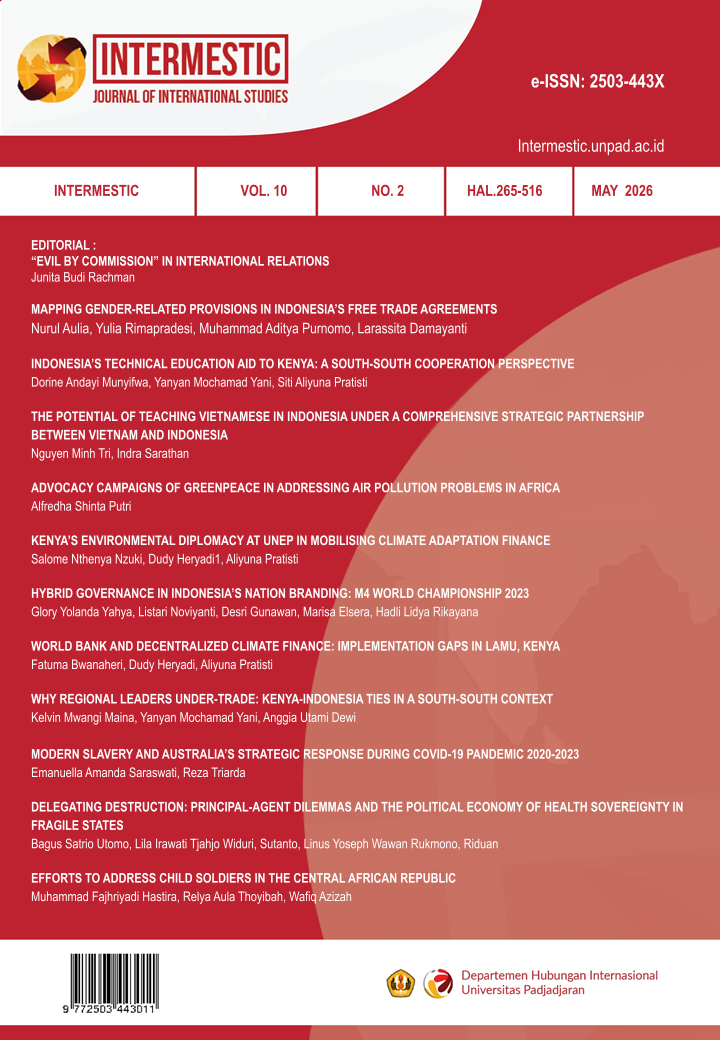
EDITORIAL: Evil By Commission in International Relations
Article Sidebar
Main Article Content
Abstract
The purpose of this essay is to explore the concept of evil in international relations, specifically focusing on evil by commission in various dimensions. In the field of international relations, the discussion of evil within the international political arena is often overlooked. In the study of International Relations, evil results from deliberate actions by agents such as states, corporations, or non-state actors, often obscured by complex bureaucracies. This framework aims to systematically analyze evil by distinguishing between material and non-material instruments and defining various impact locations. It seeks to frame evil as a subject for scientific inquiry, rather than a mere moral issue.
Article Details
Issue
Section

This work is licensed under a Creative Commons Attribution-NonCommercial-ShareAlike 4.0 International License.
The authors submitting a manuscript do so on the understanding that if accepted for publication copyright of the article shall be assigned to Intermestic: Journal of International Studies, International Relations Department, Padjadjaran University as the publisher of the journal.
References
Adeyanju, C. G. (2020). The Gender-Based Violence as an Instrument of Warfare in Armed Conflicts. Journal of Liberty and International Affairs, 6(2), 57-70. doi: https://doi.org/10.47305/JLIA2020057a DOI: https://doi.org/10.47305/JLIA2020057a
Ainle, K. (2008). Individual Agency and Responsibility for Atrocity. In R. Jeffery (Ed.), Confronting Evil in International Relations (pp. 37-60). New York: Palgrave Macmillan. DOI: https://doi.org/10.1057/9780230612532_3
Al-Sabbak, M., Ali, S. S., Savabi, O., Savabi, G., Dastgiri, S., & Savabieasfahani, M. (2012). Metal Contamination and the Epidemic of Congenital Birth Defects in Iraqi Cities. Bull Environ Contam Toxicol, 89, 937–944. DOI: https://doi.org/10.1007/s00128-012-0817-2
Alvesson, M., & Einola, K. (2022). The gaslighting of authentic leadership 2.0. Leadership, 18(6), 814-831. doi: 10.1177/17427150221125271 DOI: https://doi.org/10.1177/17427150221125271
Arendt, H. (1963). Eichmann in Jerusalem: A Report on the Banality of Evil. New York City: Viking Press.
Bâli, A. (2023). Weapons Against the Weak: International Law and the Political Economy of Coercion. Yale Journal of International Law. Retrieved from https://www.yjil.yale.edu/weapons-against-the-weak
Bloom, S. L. (2002). Trauma And the Nature of Evil. Trauma And the Nature of Evil.
Brubaker, R. (2015). Religious Dimensions of Political Conflict and Violence. Sociological Theory, 33(1), 1-19. doi: 10.1177/0735275115572153 DOI: https://doi.org/10.1177/0735275115572153
Buss, D. (2009). Rethinking Rape as a Weapon of War. Feminist Legal Studies, 17, 145-163. DOI: https://doi.org/10.1007/s10691-009-9118-5
Carpenter, A. (2014). Violence and Extremism: Sources of Sectarian Violence in Baghdad. In Community Resilience to Sectarian Violence in Baghdad. doi: 10.1007/978-1-4614-8812-5_2 DOI: https://doi.org/10.1007/978-1-4614-8812-5
Coady, C. A. (2008). Morality and Political Violence. Cambridge: Cambridge University . DOI: https://doi.org/10.1017/CBO9780511811586
Colaguori, C. (2010). Symbolic Violence and the Violation of Human Rights: Continuing Theory Sociological Critique of Domination. International Journal of Criminology and Sociological , 3(2), 388-400.
Enloe, C. (2000). Maneuvers: The International Politics of Militarizing Women's Lives. California: University of California Press. DOI: https://doi.org/10.1525/9780520923744
Fidler, D. P., & Gostin, L. O. (2008). Biosecurity in the Global Age: Biological Weapons, Public Health, and the Rule of Law. Stanford: Stanford University Press.
Frederick, R. (2018). Evil. In D. C. Poff & A. C. Michalos (Eds.), The SAGE Encyclopedia of Business Ethics and Society (pp. 1277-1279). California: SAGE Publications. doi:10.4135/9781483381503.n426 DOI: https://doi.org/10.4135/9781483381503.n426
Ganira, C. K., Savala, A., & Maseno, L. (2025). Patriarchy as a Form of Gender-Based Violence within the Religious Circle: A Pentecostal Assemblies. African Journal of Empirical Research, 6(2), 147-153. DOI: https://doi.org/10.51867/ajernet.6.2.12
Haddock, B., Roberts, P., & Sutch, P. (Eds.). (2012). Evil in Contemporary Political Theory. Edinburgh: Edinburgh University Press. DOI: https://doi.org/10.1515/9780748654123
Hameed, U., Dar, S. B., & Shahid, A. (2025). Legality of Pre-Emptive Strikes Under International Law of The Use of Force. International Journal of Social Sciences Bulletin, 3(12). doi: https://doi.org/10.5281/zenodo.18080624 Received Accepted
Hammond, P. (2007). Introduction: post-Cold War Conflict and the Media. In P. Hammond, Framing post Cold War Conflict (pp. 1-20). Manchester: Manchester University Press.
Hammond, P. (2007). Iraq 23. In Hammond, P., Framing post-Cold War Conflict. The media and international intervention (pp. 190-215). Manchester: Manchester University Press.
Hayden, P. (2014). Systemic Evil and the International Political Imagination. International Politics, 51(4), 424-440. Retrieved from http://www.palgrave-journals.com/ip/journal/v51/n4/index.html DOI: https://doi.org/10.1057/ip.2014.20
Heymann, D. (2003). The Evolving Infectious Disease Threat: Implications for National and Global Security. Journal of Human Development, 4(2), 191-207. doi:DOI:10.1080/1464988032000087541 DOI: https://doi.org/10.1080/1464988032000087541
Hinnebusch, R. (2006). The Iraq War and International Relations: Implications for Small States. Cambridge Review of International Affairs, 19(3). DOI: https://doi.org/10.1080/09557570600869507
JC, C. (2002). Health consequences of intimate partner violence. Lancet, 359, 1331–1336. doi:doi: 10.1016/S0140-6736(02)08336-8. DOI: https://doi.org/10.1016/S0140-6736(02)08336-8
Jeffery, R. (2007). Evil and International Relations: Human Suffering in an Age of Terror. New York: Palgrave Macmillan.
Jeffery, R. (2008). Introduction Evil, Responsibility and Response. In R. Jeffery (Ed.), Confronting Evil in International Relations Ethical Responses to Problems of Moral Agency (pp. 3-10). New York: Palgrave Macmillant. DOI: https://doi.org/10.1057/9780230612532_1
Jones, A., & Lower, W. (2023). Genocide and Gender: Dynamics and Consequences. I. In T. M. B. Kiernan, (Ed.), The Cambridge World History of Genocide (Chapter ed., pp. 103 - 126). Cambridge, Cambridge: Cambridge University Press. doi: https://doi.org/10.1017/9781108655989.006 DOI: https://doi.org/10.1017/9781108655989.006
Josse, E. ( 2010). They came with two guns’: the consequences of sexual violence for the mental health of women in armed conflicts. International Review of the Red Cross, 92 (877), 177-195. doi: 10.1017/S1816383110000251 DOI: https://doi.org/10.1017/S1816383110000251
Kaufman, S. J. (2019). War as Symbolic Politics. International Studies Quarterly, 1-12. DOI: https://doi.org/10.1093/isq/sqz018
Kelman, H. C. (1997). Social-Psychological Dimensions of International Conflict. In H. C. Kelman, I. W. Zartman & J. L. Rasmussen (Eds.), Peacemaking in International Conflict: Methods and Techniques (pp. 191-238.). Washington DC: United States Institute of Peace Press.
Lang, A. F. (2007). The violence of rules? Rethinking the 2003 war against Iraq. Contemporary Politics, 13(3). doi: https://doi.org/10.1080/13569770701467510 DOI: https://doi.org/10.1080/13569770701467510
Lawrence, M. J., Stemberger, H. L., Zolderdo, A. J., Struthers, D. P., & Cooke, S. J. (2015). The effects of modern war and military activities onbiodiversity and the environment. Environ. Rev, 23, 43–460 . doi: dx.doi.org/10.1139/er-2015-0039 DOI: https://doi.org/10.1139/er-2015-0039
Leatherman. (2011). Sexual violence and armed conflict. Malden, MA: Polity Press.
Liebling, H., & Kiziri-Mayengo, R. (2002). The psychological effects of gender-based violence following armed conflict in Luwero District, Uganda. Feminism & Psychology, 12, 553–560. doi: 10.1177/0959353502012004015. DOI: https://doi.org/10.1177/0959353502012004015
Lindgren, T., & Sonnenschein, H. (2021). Bloody, Intense, And Durable: The Politics of ‘Religious Conflict . Nordic Journal of Comparative Religion, 57(1), 59-80. doi: 10.33356/temenos.95992 DOI: https://doi.org/10.33356/temenos.95992
Melissen, J. (2005). The New Public Diplomacy Soft Power in International Relations. (J. Mellisan) Houndmills: Palgrave Macmillan. DOI: https://doi.org/10.1057/9780230554931
Nations, U. ( 2024, February 15 February 2024). Stories from the UN Archive: The presentation that launched a war. Retrieved from United Nations, UN News: Global perspective Human stories: https://news.un.org/en/story/2024/02/1146332
Nymalm, N., & Plagemann, J. (2019). Comparative Exceptionalism: Universality and Particularity in Foreign Policy Discourses. International Studies Review, 21(1), 12-37. DOI: https://doi.org/10.1093/isr/viy008
Panigaj, J., & Berníková, E. (2023). Ecocide - a new crime under international law? Juridical Tribune, 13(1). doi: 10.24818/TBJ/2023/13/1.01 DOI: https://doi.org/10.24818/TBJ/2023/13/1.01
Pérez-Sales, P. (2016). Psychological Torture: Definition, Evaluation and Measurement. London: Routledge. DOI: https://doi.org/10.4324/9781315616940
Price-Smith, A. T. (2009). Contagion and Chaos: Disease, Ecology, and National Security in the Era of Globalization. Cambridge: MIT Press. DOI: https://doi.org/10.7551/mitpress/7390.001.0001
Randhawa, S. H. (2022). International criminalization and the historical emergence of international crimes. International Theory, 14(3), 460-502. doi: 10.1017/S1752971922000021 DOI: https://doi.org/10.1017/S1752971922000021
Rech, W. (2021). The Naming of Evil: Sovereignty, Security and Unlawful Warfare. Isonomía (54), 76-128. doi: 10.5347/isonomia.v0i54.433 DOI: https://doi.org/10.5347/isonomia.v0i54.433
Rengger, N. J., & Jeffery, R. (2005). Moral evil and international relations. SAIS Review of International Affairs, 25(1), 3-16. DOI: https://doi.org/10.1353/sais.2005.0016
Rodenhauser, T. (2014). Beyond State Crimes: Non-State Entities and Crimes against Humanity. Leiden Journal of International Law, 27(4), 913 - 928. doi: https://doi.org/10.1017/S0922156514000417 DOI: https://doi.org/10.1017/S0922156514000417
Singer, P. (2004). The President of Good and Evil: The Ethics of George W. Bush . New York: Dutton.
Sinha, G. A. (2020). Lies, Gaslighting and Propaganda. Buffalo Law Review, 68(4).
Staub, E. (1992). The Roots of Evil: The Origins of Genocide and Other Group Violence. Cambridge: Cambridge University Press.
Tabbert, U. (2013). Crime through a corpus: The linguistic construction of offenders, victims and crimes in the German and UK Press. Doctoral thesis, University of Huddersfield. doi: https://doi.org/10.1057/9780230392083_12 DOI: https://doi.org/10.1057/9780230392083_12
Thomas, W. (2001). The Ethics of Destruction: Norms and Force in International Relations . Ithaca: Cornell University Press,.
Vetlesen, A. J. (2005). Evil and Human Agency. Cambridge: Cambridge University Press. DOI: https://doi.org/10.1017/CBO9780511610776
Vetlesen, A. J. (2008). Collective Evildoing. In R. Jeffery (Ed.), Confronting Evil in International Relations (pp. 61-88). New York: Palgrave Macmillan. DOI: https://doi.org/10.1057/9780230612532_4
Vincent, T. (2014). Control And Manipulation of International Organizations By Developed Countries Developed Countries, Torty Vincent (PhD. Thesis). Retrieved from https://www.researchgate.net/publication/360318214_CONTROL_AND_MANIPULATION_OF_INTERNATIONAL_ORGANIZATIONS_BY_DEVELOPED_COUNTRIES
Wani, N. A., & Wani, O. A. (2023). “Patriarchy And Religion: The Exploitation Of Women”. International Journal of Creative Research Thoughts (IJCRT), 11(6).
Westing, A. H. (1980). Warfare in a Fragile World Military Impact on the Human Environment. London: Taylor & Frands Ltd.
Wheelis, M., & Lajos Rózsa, M. D. (2006). Historical Context and Overview. In M. Wheelis & M. D. L. Rózsa (Eds.), Deadly Cultures: Biological Weapons Since 1945 (pp. 1-8). Harvard: University Press. DOI: https://doi.org/10.4159/9780674045132-002
Wilde, M. D. (2018). Enemy of All Humanity The Dehumanizing Effects of a Dangerous Concept. Netherlands Journal of Legal Philosophy, 47(2), 158-175. doi: 10.5553/NJLP/221307132018047002005 DOI: https://doi.org/10.5553/NJLP/221307132018047002005
Wirtu, Y. D., & Abdela, U. (2025). Impact of war on the environment: ecocide. Frontiers in Environmental Science, 1-25. doi: 10.3389/fenvs.2025.1539520 DOI: https://doi.org/10.3389/fenvs.2025.1539520