
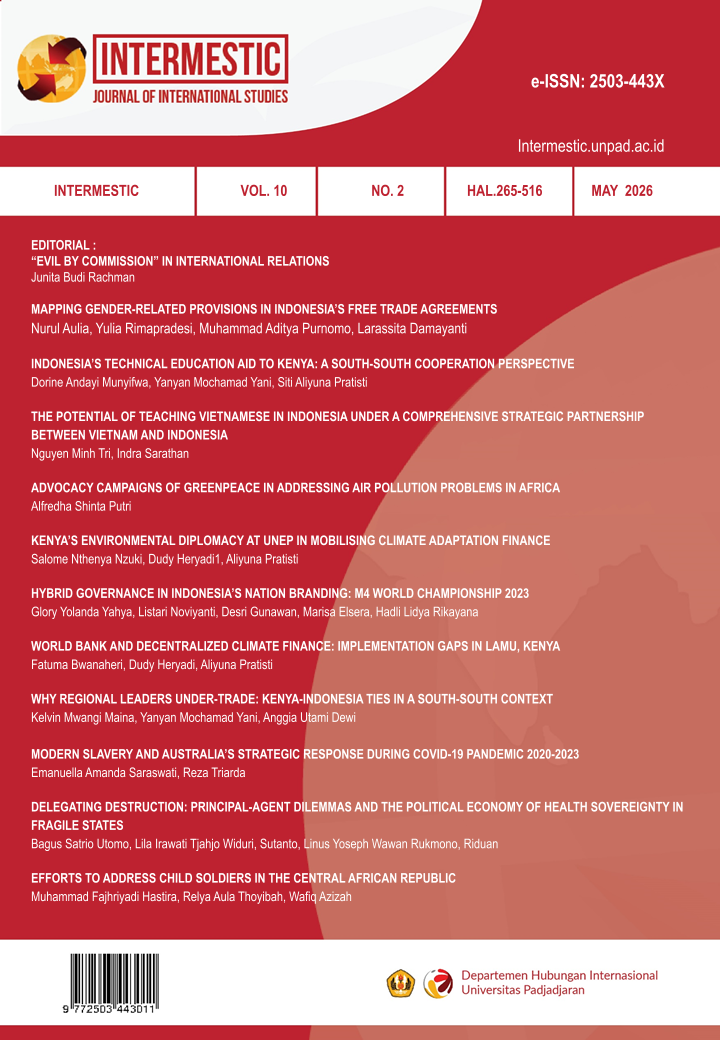
KENYA’S ENVIRONMENTAL DIPLOMACY AT UNEP IN MOBILISING CLIMATE ADAPTATION FINANCE
Article Sidebar
Main Article Content
Abstract
Climate change causes devastating socio-economic and environmental effects. Developing countries like Kenya that contribute little to global greenhouse emissions are disproportionately affected. This paper explores how Kenya’s environmental diplomacy at the United Nations Environment Programme (UNEP) contributes to mobilisation of climate adaptation finance. The study is guided by concepts of environmental diplomacy and climate finance, utilizing qualitative research methods through semi-structured interviews and documentary analysis. The findings demonstrate that through environmental diplomacy at UNEP, Kenya strengthens diplomatic visibility, builds coalitions and global partnerships that would indirectly increase the chances of securing climate finance. Nonetheless, some drawbacks hinder the transformation of Kenya’s diplomatic leverage into concrete financial outcomes. These include geopolitics, institutional separation of UNEP and United Nations Framework Convention on Climate Change (UNFCCC), competition, bureaucracy and national institutional capacity. This research contributes to academic discourse on environmental diplomacy, affirming that to effectively mobilise climate finance, a country must balance between diplomacy, reinforcing national institutions and engagement with global governance structures.
Article Details
Issue
Section

This work is licensed under a Creative Commons Attribution-NonCommercial-ShareAlike 4.0 International License.
The authors submitting a manuscript do so on the understanding that if accepted for publication copyright of the article shall be assigned to Intermestic: Journal of International Studies, International Relations Department, Padjadjaran University as the publisher of the journal.
References
Althor, G., Watson, J. E. M., & Fuller, R. A. (2016). Global mismatch between greenhouse gas emissions and the burden of climate change. Scientific Reports, 6, Article 20281. https://doi.org/10.1038/srep20281 DOI: https://doi.org/10.1038/srep20281
Bhandary, R. R., Gallagher, K. S., & Zhang, F. (2021). Climate finance policy in practice: a review of the evidence. Climate Policy, 21(4), 529–545. https://doi.org/10.1080/14693062.2020.1871313 DOI: https://doi.org/10.1080/14693062.2020.1871313
Braun, V., & Clarke, V. (2006). Using thematic analysis in psychology. Qualitative Research in Psychology, 3(2), 77–101. https://doi.org/10.1191/1478088706qp063oa DOI: https://doi.org/10.1191/1478088706qp063oa
Buchner, B., Clark, A., Falconer, A., Macquarie, R., Meattle, C., Tolentino, R., & Wetherbee, C. (2019). A CPI Report. https://climatepolicyinitiative.org/publication/
Climate Policy Initiative. (2022). Study on climate finance flows in Kenya reveals a need for significant increase in funding for critical sectors - CPI. https://www.climatepolicyinitiative.org/press-release/study-on-climate-finance-flows-in-kenya-reveals-a-need-for-significant-increase-in-funding-for-critical-sectors/
Creswell, J. W., & Creswell, J. D. (2018). Research design: Qualitative, quantitative, and mixed methods approaches (5th ed.). SAGE Publications.
Feulner, G. (2015). Global Challenges: Climate Change. Global Challenges, 1(1), 5. https://doi.org/10.1002/GCH2.1003 DOI: https://doi.org/10.1002/gch2.1003
Giglio, S., Kelly, B., & Stroebel, J. (2021). Climate finance. Annual Review of Financial Economics, 13, 15–36. https://doi.org/10.1146/annurev-financial-102620-103311 DOI: https://doi.org/10.1146/annurev-financial-102620-103311
Government of Kenya. (2024). Foreign Policy of The Republic of Kenya.
Guyo, W. K., Sabala, K., & Rotich, G. (2024). The Role of Environmental Diplomacy on Climate Change Adaptation in Kenya. https://doi.org/10.5281/ZENODO.12788611
Harmsen, H. (2018). Effectiveness of UNFCCC in addressing climate change.
Ivanova, M. (2010). UNEP in global environmental governance: Design, leadership, location. Global Environmental Politics. DOI: https://doi.org/10.1162/glep.2010.10.1.30
Kasaija, P. A. (2019). Kenya’s environmental diplomacy and global climate governance. African Journal of International Affairs, 16(2), 45–62.
Kenya Vision 2030. (n.d.). Kenya Vision 2030. Retrieved September 2, 2025, from https://vision2030.go.ke/
Lamont, C. (2015). Research methods in international relations. SAGE Publications.
Li, G., Zakari, A., & Tawiah, V. (2020). Does environmental diplomacy reduce CO2 emissions? A panel group means analysis. Science of The Total Environment, 722, 137790. https://doi.org/10.1016/J.SCITOTENV.2020.137790 DOI: https://doi.org/10.1016/j.scitotenv.2020.137790
Ochieng, J., Kirimi, L., & Mathenge, M. (2016). Effects of climate variability and change on agricultural production: The case of small scale farmers in Kenya. NJAS - Wageningen Journal of Life Sciences, 77, 71–78. https://doi.org/10.1016/J.NJAS.2016.03.005 DOI: https://doi.org/10.1016/j.njas.2016.03.005
Odhengo, P., Atela, J., Steele, P., Orindi, V., & Imbali, F. (2024). Climate Finance in Kenya: Review and Future Outlook.
Okoth, M. A. (2021). Climate diplomacy and sustainable development in Africa: The case of Kenya. Journal of African Foreign Affairs, 8(1), 67–88.
Ouma, M. (2023). Climate adaptation in Kenya Narratives and frames shaping policy and practice (NAI Working Papers No. 1). Nordiska Afrikainstitutet. https://cgspace.cgiar.org/items/cf945cd7-7113-45aa-abcd-0b6b21bb6277
Powanga, L., & Kwakwa, P. A. (2024). Determinants of carbon emissions in Kenya and policy implications. Journal of Environmental Management, 370, 122595. https://doi.org/10.1016/J.JENVMAN.2024.122595 DOI: https://doi.org/10.1016/j.jenvman.2024.122595
Schalatek, L., & W. C. (2020). The Green Climate Fund and climate finance: Access and governance challenges.
Steckel, J. C., Jakob, M., Flachsland, C., Kornek, U., Lessmann, K., & Edenhofer, O. (2017). From climate finance toward sustainable development finance. Wiley Interdisciplinary Reviews: Climate Change, 8(1), e437. https://doi.org/10.1002/WCC.437 DOI: https://doi.org/10.1002/wcc.437
Stroebel, J., & Wurgler, J. (2021). What do you think about climate finance? Journal of Financial Economics, 142(2), 487–498. https://doi.org/10.1016/J.JFINECO.2021.08.004 DOI: https://doi.org/10.1016/j.jfineco.2021.08.004
The Constitution of Kenya. (2010). The Constitution of Kenya, 2010. www.kenyalaw.org
UNEP. (n.d.). How Nairobi came to host UNEP’s headquarters. Retrieved September 1, 2025, from https://www.unep.org/news-and-stories/story/how-nairobi-came-host-uneps-headquarters
UNEP. (2025). About the United Nations Environment Programme | UNEP - UN Environment Programme. https://www.unep.org/who-we-are/about-us
UNFCCC. (n.d.-a). Introduction | UNFCCC. Retrieved September 16, 2025, from https://unfccc.int/topics/adaptation-and-resilience/the-big-picture/introduction
UNFCCC. (n.d.-b). Introduction to Climate Finance | UNFCCC. Retrieved September 15, 2025, from https://unfccc.int/topics/introduction-to-climate-finance
United Nations Development Programme (UNDP). (2024). What is climate change adaptation and why is it crucial? | UNDP Climate Promise. https://climatepromise.undp.org/news-and-stories/what-climate-change-adaptation-and-why-it-crucial
Volchenko, N., Zhmakin, S., Udovenko, R., Soldatkin, S., & Soldatkin, I. (2023). Combating Climate Change Through the International Law Perspective: The Role of the EU in Environmental Diplomacy. European Energy and Environmental Law Review, 32(5), 257–266. https://doi.org/10.54648/EELR2023016 DOI: https://doi.org/10.54648/EELR2023016
Wambugu, G. (2020). Institutional challenges in mobilising climate finance in Kenya. African Journal of Public Policy, 12(1), 87–107.
World Economic Forum. (2025). Removing adaptation finance risks helps investments scale | World Economic Forum. https://www.weforum.org/stories/2025/06/scaling-up-adaptation-finance-with-derisking-approaches/
Yin. (2018). In 2018 Case Study | PDF | Data Analysis | Data. https://www.scribd.com/document/687414473/YIn-2018-Case-Study